





In case you missed it see what’s in this section
Let's Talk
Your Total Guide To business

Who Provides Institutional-Grade Digital Asset Trading Platforms?
Short answer. Institutional-grade digital asset trading platforms come from four distinct provider types. Multi-asset OEMS vendors (Quod Financial, FlexTrade, TS Imagine) run digital assets on the same architecture as equities, derivatives and FX. Crypto-native execution platforms (Talos, Wyden, Elwood, FalconX) are purpose-built for digital assets alone. Custody-first platforms (Fidelity Digital Assets, Anchorage Digital, BitGo, Fireblocks) lead with safekeeping and add execution on top. Exchange and broker desks (Coinbase Prime, StoneX Digital, Kraken Institutional) supply liquidity and clearing directly. The right category depends on one question: is crypto your only asset class, or your newest one?
On 1 July 2026, the transitional regime under the EU's Markets in Crypto-Assets Regulation ended. There were no extensions. Firms serving EU clients without a full CASP authorisation moved from "in transition" to "in breach", with penalties reaching 12.5% of annual turnover.
The consequences were immediate and visible. Binance withdrew its Greek authorisation application in June 2026 and subsequently notified users in France, Spain, Italy and Poland that it could no longer provide crypto-asset services to them.
For an institutional desk, that is not a compliance story. It is a routing story. A venue that carried real size for European flow left the map with weeks of notice. Any desk whose execution logic was hard-wired to a fixed venue list had to re-plumb.
This is why the question "who provides institutional-grade digital asset trading platforms" no longer has a single-vendor answer. It has a categorical one.
The provider landscape in four categories
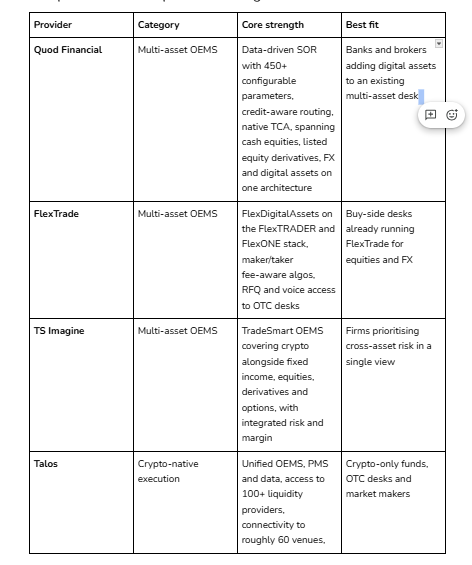
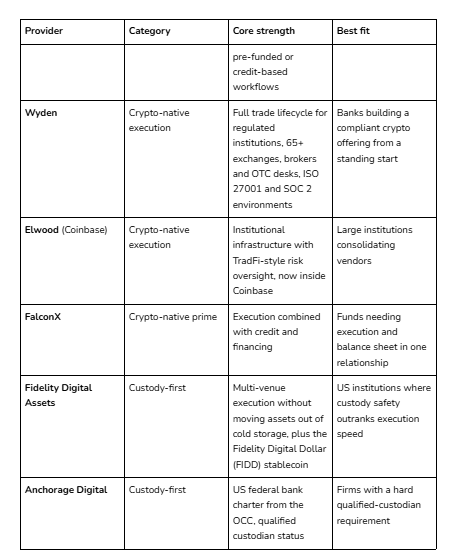
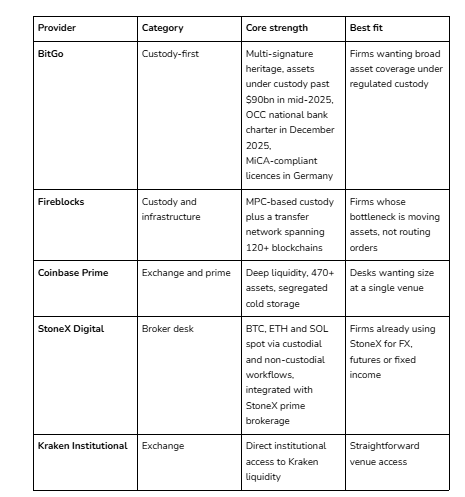
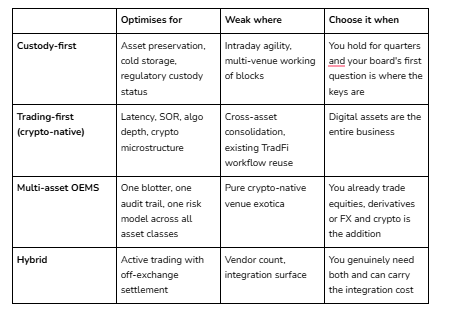
The table above is the useful shape of this market. The four categories are not competing for the same buyer.
Multi-asset OEMS vendors
These are order and execution management systems built originally for traditional markets, with digital assets added as an asset class rather than as the product.
The distinction matters more than it sounds. A bank that already trades cash equities, listed derivatives and FX does not have a crypto problem. It has an integration problem. Its traders, its compliance team, its middle office and its reporting stack all exist. Bolting on a separate crypto platform means a second blotter, a second audit trail, a second set of risk limits and a second reconciliation.
Quod Financial is the clearest example of this model. The firm has been building execution technology since 2004 and launched a data-driven smart order router and algo suite in 2008. Digital assets run on that same architecture, alongside cash equities, listed equity derivatives and FX. Its SOR exposes over 450 configurable parameters, supports credit-aware routing and pre-funding logic, and feeds a native TCA layer built for MiFID II reporting. Algo coverage includes TWAP, VWAP, implementation shortfall, participation and auction volume percentage for futures and perpetuals.
FlexTrade takes a comparable route with FlexDigitalAssets, delivering crypto liquidity into the same blotter its clients already use for equities and FX, with algos tuned for maker/taker fee optimisation. In July 2026 it integrated EDX Markets' central limit order book directly into that blotter. TS Imagine positions TradeSmart OEMS the same way, with crypto sitting next to fixed income, equities and options under one risk model.
One important clarification. None of these vendors is a CASP. They supply technology. The MiCA authorisation obligation sits with the institution operating the desk, not with the software it runs on. That separation is a feature, not a gap: a technology vendor with no balance sheet, no client assets and no venue ownership has no structural conflict when its router decides where your order goes.
Crypto-native execution platforms
Built from a blank sheet for digital assets, with no legacy to carry.
Talos unifies OEMS, PMS and data across the investment lifecycle, offering access to more than 100 liquidity providers and connectivity to roughly 60 venues across spot, perpetuals, futures and options. Wyden targets regulated banks and brokers specifically, with 65+ venues and operations inside ISO 27001 and SOC 2 environments, and a heavy emphasis on auditable, best-execution workflows. Elwood, now part of Coinbase, brings TradFi-style risk oversight. FalconX combines execution with credit.
These platforms win decisively where digital assets are the whole business. Their depth of venue coverage and crypto-specific microstructure knowledge is hard to match. They win less easily where crypto is a fifth asset class on an existing desk, because they arrive as an additional system rather than an extension of one.
Custody-first platforms
Here, safekeeping is the product and execution is downstream of it.
Fidelity Digital Assets lets institutions access multi-venue liquidity without moving assets out of cold storage, and has launched its own institutional stablecoin. Anchorage Digital holds a US federal bank charter from the OCC, making it a qualified custodian under US banking law. BitGo, which helped define institutional custody with multi-signature architecture, crossed $90bn in assets under custody in mid-2025, secured an OCC national bank charter in December 2025 and holds MiCA-compliant licences in Germany. Fireblocks operates MPC-based custody with a transfer network reaching across 120+ blockchains.
The trade-off is consistent: maximum asset security, less execution agility. For a long-only allocator holding positions for quarters, that trade is obviously correct. For a desk working blocks across venues intraday, it is obviously wrong.
Exchange and broker desks
Coinbase Prime supports 500+ pairs across spot and futures with segregated cold storage, and its execution desk handles large orders from $250,000 upward. StoneX Digital offers spot BTC, ETH and SOL through custodial and non-custodial workflows, integrated with StoneX's prime brokerage across fixed income, equities and futures. Kraken Institutional provides direct access to Kraken liquidity.
These are venues and counterparties, not neutral infrastructure. They are excellent as a liquidity source and structurally unsuited as your only routing layer, for the obvious reason that a venue routing your order has an interest in where it lands.
What institutions actually screen for in 2026
The selection criteria moved sharply, and the data is unambiguous.
Coinbase and EY-Parthenon surveyed 351 institutional decision-makers in January 2026. The single most revealing finding is what happened to custodian selection criteria year on year:
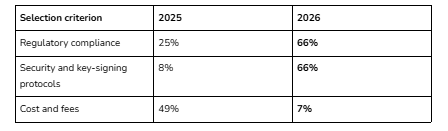
Cost collapsed from the top consideration to a rounding error in twelve months. Institutions stopped shopping on price. They are now paying a premium for provable compliance and provable security, which is a signal that the buyer changed, not that the market got expensive.
The rest of the survey sharpens the picture. 73% of respondents plan to increase digital asset allocations in 2026 and 74% expect prices to rise over the next twelve months, yet 49% said recent volatility pushed their firm to tighten risk management, liquidity and position sizing. Only 8% treated that volatility as an opportunity. 61% now run a multi-custodian model, rising to 69% among the largest institutions, which is counterparty diversification rather than technical redundancy.
Read together: institutions are allocating more, and trusting less. That combination is precisely what drives demand for infrastructure that is venue-agnostic, custodian-agnostic and fully auditable.
Where regulation actually bites
66% cite regulatory uncertainty as their primary concern, and 65% cite regulatory clarity as their main reason to increase allocations. The same variable is both the accelerator and the brake, which is why the MiCA deadline mattered so much.
Where security actually bites
Multi-Party Computation is now the baseline for key management, splitting private keys into shards so that no single party ever assembles the whole. It is typically combined with hardware-backed authentication such as FIDO2, air-gapped cold storage for long-term holdings, and a strict separation between the entity executing the trade and the entity holding the assets. That separation mirrors traditional equity market structure and exists for a single reason: it makes internal fraud require collusion.
Where execution actually bites
Execution quality is the one criterion that survives every market regime, and the only one that is measurable in basis points. Transaction cost analysis compares fills against benchmarks and identifies where value leaks. In practice, TCA is what turns "our execution is good" into a number a compliance committee can sign.
How MiCA reshaped the EU venue map on 1 July 2026
As of early July 2026, ESMA's interim register listed roughly 280 authorised CASPs across 25 EEA member states.
The composition tells the real story:
- 182 (65%) are crypto-native firms. Exchanges, brokers, custodians.
- 98 (35%) are traditional financial institutions that added crypto services alongside existing regulated activities.
- Germany alone holds around 20% of all EU CASP licences, reflecting BaFin's prior crypto-custody experience and a deep institutional base.
- Custody is the backbone permission, held by roughly 61% of authorised firms.
- Only 15 of the world's 100 largest exchanges are MiCA-licensed.
That last number is the one to sit with. If you are routing European flow, the licensed universe is a filtered subset of the global venue map, not the whole of it. A CASP authorised in one member state passports across the bloc, so the licence is EU-wide, but the venue either has one or it does not.
There is a second-order effect on settlement. Tether has not obtained e-money token authorisation as of mid-2026, which has restricted USDT trading on several licensed exchanges. Some CASPs permit USDT custody without permitting it to be bought or sold on the order book. If your settlement leg assumed USDT liquidity on an EU venue, that assumption needs re-testing.
What a licence-filtered venue map means for execution
Three practical consequences.
Routing must be licence-aware, not just price-aware. The cheapest fill on an unlicensed venue is not a fill you can book for an EU client. Best execution policy now has a regulatory pre-filter ahead of the price comparison.
Venue sets are no longer static. Binance's EU exit is the proof. Any desk that treats its connectivity list as a configuration file it edits once a year has an operational risk it has not priced.
Vendor neutrality became a hard requirement. When the venue map moves, you need to re-point flow without re-platforming. That is only possible if your execution layer was never tied to a particular venue's commercial interest in the first place.
Trading-first, custody-first, or multi-asset OEMS?
When a crypto-native platform wins
When your firm has no legacy stack to integrate with, when venue coverage breadth is the binding constraint, and when your traders live entirely inside digital asset microstructure. A crypto-native platform arriving as your only system is not a fragmentation problem.
When a custody-first platform wins
When execution frequency is low and asset safety is the entire mandate. A long-only allocator with a multi-quarter horizon has no use for sub-millisecond routing and every use for a qualified custodian with a bank charter.
When a multi-asset OEMS wins
When digital assets are the newest line on a desk that already runs equities, derivatives or FX. The argument is not that a multi-asset OEMS routes crypto better than Talos routes crypto. It is that a second platform means a second blotter, a second compliance surface, a second reconciliation and a second thing to explain to an auditor.
A desk running Quod Financial's crypto OEMS applies the same care-order handling, the same DMA, the same pre-trade risk checks, the same kill switch and the same TCA to a BTC block that it applies to a cash equity block.
The workflow does not fork by asset class. For a bank or broker, that is usually the decisive variable, and it is rarely the one the comparison articles measure.
How liquidity is managed across fragmented venues
Digital asset liquidity is scattered across centralised exchanges, decentralised exchanges, OTC desks, market makers and internal pools, each with its own rules, fees and constraints. Aggregation is not a nice-to-have.
Smart order routing scans connected venues in real time and splits orders toward the deepest and cheapest liquidity. The quality difference between routers is not whether they do this, but what they route on. Price alone is a naive router. Quod's SOR evaluates price, volume, latency and fees together, with machine learning feeding back on configuration, which is a direct inheritance from the equities SOR the firm shipped in 2008.
Credit-aware routing is where crypto genuinely differs from equities. Pre-funding every venue is dead capital, and post-FTX, capital parked on a venue is capital at risk. Routers that understand credit availability and can pre-fund predictively, rather than statically, materially change the carry cost of running a multi-venue book. Talos supports both pre-funded and credit-based workflows. Quod applies volume prediction to balance credit and pre-fund executions.
Execution algorithms work the block. TWAP, VWAP, implementation shortfall and participation strategies spread size over time to limit market impact. This is old technology in equities and comparatively recent in crypto, which is precisely why platforms with a TradFi lineage have an advantage here rather than a handicap.
How these platforms plug into an existing trading stack
FIX remains the native language of institutional messaging, and most order management systems already speak it.
A digital asset platform that supports FIX plugs into the existing desk without a rebuild. REST APIs handle the non-latency-sensitive work: balances, history, back-office reconciliation. WebSockets carry the continuous stream of order status and market data.
The workflows themselves transfer more cleanly than most firms expect. Digital asset trading and spot FX share pair-based trading, near-continuous sessions and bilateral liquidity relationships. The genuine differences are settlement technology, 24/7 rather than 24/5 operation, and blockchain-specific mechanics such as gas costs. The staffing model changes more than the trading model does.
What to measure after the trade
Transaction cost analysis compares fills to benchmarks and locates where value leaked. Real-time TCA lets an algo throttle itself when slippage breaches a threshold. Post-trade TCA is what a fiduciary shows a client, and what a regulator asks for.
Settlement is where counterparty risk concentrates. Delivery-versus-payment ensures assets move only once payment confirms. Atomic settlement on-chain compresses the settlement gap toward zero. Third-party clearing puts a buffer between your desk and a venue's solvency, which stopped being theoretical in November 2022.
Pre-trade risk controls are the part that prevents the loss rather than measuring it. Fat-finger checks, volume checks, trading and position limits, margin management, net open position monitoring, credit availability checks and a kill switch. Institutional platforms treat these as mandatory. The 49% of institutions that tightened risk management after the Q4 2025 volatility were, in practice, buying this list.
Tokenisation and stablecoins: the next infrastructure question
Institutional interest in tokenised assets reached 63% in the 2026 survey, up from 57% in 2025, and over 60% of respondents expect meaningful integration of blockchain rails into trading, clearing and settlement within three to five years.
The demand is concrete rather than speculative. The highest-interest use cases are T+0 securities settlement at 88%, internal cash management and money movement at 85%, and 24/7 trading also at 85%. Collateral management sits at 77%. DeFi yield sits at 30%, which tells you where the institutional line currently falls.
Stablecoins have moved from a trading utility to a settlement layer, used to manage cash and settle trades in near real time. The constraint is regulatory rather than technical: under MiCA, a stablecoin needs e-money token authorisation to trade freely on an EU venue, and the largest one does not have it yet.
Choosing, in one paragraph
If digital assets are your whole business, buy a crypto-native platform. If you are holding rather than trading, buy custody. If you are a venue's client and want their liquidity, use their desk. And if you already run equities, derivatives or FX and crypto is the newest asset class on the blotter, the question is not which crypto platform to add. It is why you would add one at all, rather than extend the OEMS you already trust.
Frequently asked questions
Which providers offer institutional-grade platforms for digital asset trading?
Four categories. Multi-asset OEMS vendors including Quod Financial, FlexTrade and TS Imagine run digital assets on the same architecture as equities, derivatives and FX. Crypto-native execution platforms including Talos, Wyden, Elwood and FalconX are built for digital assets alone. Custody-first platforms including Fidelity Digital Assets, Anchorage Digital, BitGo and Fireblocks lead with safekeeping. Exchange and broker desks including Coinbase Prime, StoneX Digital and Kraken Institutional supply liquidity directly.
The categories serve different buyers. A crypto-only hedge fund and a Tier-1 bank adding a fifth asset class are not shopping in the same aisle, even though they use the same search terms.
What is a crypto OEMS, and how is it different from a crypto exchange?
A crypto OEMS is an order and execution management system: the software layer a desk uses to manage, route and execute orders across many venues, apply risk controls and measure execution quality. An exchange is one of the venues it routes to. The OEMS is neutral infrastructure; the exchange is a counterparty. Institutions use both, for different reasons.
Does a trading technology vendor need a MiCA CASP licence?
No. MiCA authorisation attaches to the entity providing crypto-asset services to clients, not to the software vendor supplying its trading technology. The obligation sits with the institution operating the desk. What the platform must do is support the audit trail, reporting and controls that the licensed institution needs to evidence compliance.
What changed for EU institutions on 1 July 2026?
The MiCA transitional regime ended with no extensions. Firms serving EU clients without full CASP authorisation are now operating unlawfully, with penalties reaching 12.5% of annual turnover. Roughly 280 CASPs are authorised across 25 EEA states, but only 15 of the world's 100 largest exchanges hold a licence. Binance withdrew its Greek application in June 2026 and stopped serving several EU markets. The practical impact for desks is that the licensed venue universe is now a filtered subset of the global one, and routing logic has to know the difference.
How do institutions manage liquidity across fragmented venues?
Through smart order routing and liquidity aggregation, pooling exchange, DEX, OTC and market-maker liquidity into a single view and splitting orders toward the best available depth. Credit-aware routing and centralised settlement networks let firms trade across venues without pre-funding each account, which cuts both counterparty exposure and cost of carry. Execution algorithms such as TWAP, VWAP and implementation shortfall then work the size down over time to limit market impact.
What do institutions prioritise when selecting a provider?
Compliance and security, decisively. In the January 2026 Coinbase and EY-Parthenon survey of 351 institutional decision-makers, regulatory compliance rose from 25% to 66% as a selection criterion year on year, and security protocols rose from 8% to 66%. Cost and fees fell from 49% to 7%. Institutions are paying for provable controls rather than shopping for the cheapest venue.
How do digital asset platforms integrate with existing trading systems?
Through FIX for order messaging, plus REST and WebSocket APIs for balances, history and real-time streaming.
That lets a digital asset platform plug into an existing OMS or PMS rather than replacing it. Firms with an established equities, derivatives or FX stack can extend it rather than run a parallel one, which is the core argument for a multi-asset OEMS over a standalone crypto platform.









Weather in Bristol
Listings
 Update cookies preferences